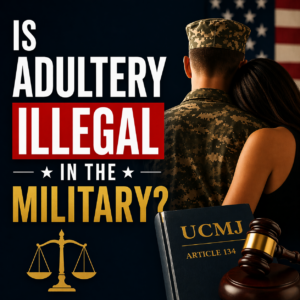
Is Adultery Illegal in the Military?
Yes. Adultery can be illegal in the military. The offense now appears in the 2024 Manual for Courts-Martial as “extramarital sexual conduct” under Article 134.
What the military calls adultery
The Manual for Courts-Martial does not use “adultery” as the formal offense title. It uses “extramarital sexual conduct,” placing that offense under Article 134 with defined elements, explanations, defenses, and maximum punishment.
Is adultery automatically a crime in the military?
No. The manual requires the government to prove more than a consensual affair. It must show that the accused wrongfully engaged in extramarital conduct, knew that either party was married to someone else, and that the conduct prejudiced good order and discipline, brought discredit on the armed forces, or both.
That standard explains why not every affair results in a court-martial. A cheating allegation alone does not satisfy Article 134. The government must connect the conduct to military harm or service discredit. That said, a commander has the discretion to determine that the act itself, depending on the circumstances, is sufficient to bring discredit upon the armed forces. This means the surrounding facts do not always need to be extreme for the service-discredit element to be met.
What counts as extramarital sexual conduct?
The 2024 edition defines extramarital sexual conduct to include genital-to-genital intercourse, oral-to-genital intercourse, anal-to-genital intercourse, and oral-to-anal intercourse. It also states that a marriage continues until a competent state or foreign jurisdiction dissolves it.
The manual recognizes limited defenses: legal separation can matter in certain circumstances, and a mistake-of-fact defense applies when the accused honestly and reasonably believed that both parties were unmarried, legally separated, or lawfully married to each other.
When adultery becomes a military case
The manual directs commanders and factfinders to examine the surrounding facts, including rank and position, misuse of government time or resources, effect on duty performance, whether the conduct continued after counseling or orders to stop, whether the relationship involved someone connected to the armed forces, and whether the conduct became open or notorious.
In practice, those factors usually drive the outcome. An affair that affects a unit, undermines leadership, disrupts duty performance, or embarrasses the service creates far more legal exposure than a purely private relationship with no measurable military effect. Conduct violates Article 134 when it has an obvious and measurable effect on discipline, morale, cohesion, or efficiency, or when it tends to bring the service into disrepute. Importantly, a commander is not required to identify specific collateral damage — the commander may determine that the act of extramarital sexual conduct, standing alone, is inherently service-discrediting under the circumstances.
Cases involving supervisors and subordinates, public scandal, misuse of government property, or conduct that continued after a lawful order draw especially close attention — those facts directly support the required showing of prejudice to good order and discipline or service-discrediting conduct.
How often does adultery actually lead to a court-martial?
Less often than many service members fear. Court-martials for extramarital sexual conduct are relatively uncommon. The more typical outcome is administrative. A reprimand, an adverse evaluation, or nonjudicial punishment is the most common outcome. Full criminal prosecution tends to be reserved for cases where the military impact is clear and substantial: a commander who had an affair with a subordinate, a case involving misuse of government resources, or conduct that continued after an explicit order to stop. However, service members should not assume that a discreet or private affair is automatically safe — a commander retains the authority to conclude that the conduct itself reflects poorly on the armed forces, regardless of whether it caused any visible disruption.
That said, “avoiding a court-martial” does not mean avoiding consequences. Administrative and nonjudicial responses can still damage or end a military career.
Can the military punish adultery without a court-martial?
Yes. Commanders may respond to an adultery allegation with counseling, reprimands, adverse evaluations, nonjudicial punishment, or administrative separation. Article 134 provides the criminal framework, but it does not require every case to go to trial.
A service member may avoid a criminal conviction and still face serious career consequences if the command concludes the conduct damaged trust, judgment, or the unit climate.
What is the maximum punishment?
The 2024 edition sets the maximum punishment for extramarital sexual conduct at a dishonorable discharge, forfeiture of all pay and allowances, and confinement for up to one year. That is the authorized ceiling, not the required outcome in every case.
If you are being accused of adultery in the military
If you are facing an adultery allegation, consult with an experienced military defense attorney right away. These cases often turn on the surrounding facts, the command response, and whether the government can actually prove prejudice to good order and discipline or service-discrediting conduct. Early legal advice shapes how you respond to investigators, your command, and any proposed disciplinary or administrative action. The government must prove more than a private affair — it must prove every required element of Article 134.
FAQ: adultery and military law
Can you get court-martialed for adultery in the military?
Yes. Extramarital sexual conduct is a punishable offense under Article 134 when the government proves all required elements. In practice, court-martials are the exception rather than the rule. Administrative action is the more common result.
Is cheating on your spouse always punishable under the UCMJ?
Not automatically. The manual requires more than proof of an affair. The government must also establish military impact or service discredit. But that bar is lower than many people assume. A commander has broad discretion to conclude that extramarital conduct is service-discrediting on its own.
What if the couple was separated?
A marriage continues until a competent jurisdiction legally dissolves it. However, the manual recognizes legal separation as relevant in limited circumstances.
What is the punishment for adultery in the military?
The 2024 edition lists a maximum punishment of dishonorable discharge, forfeiture of all pay and allowances, and confinement for up to one year. Most cases do not reach that ceiling.
Bottom line
Adultery can be illegal in the military. The formal offense is extramarital sexual conduct under Article 134. The government must prove both the conduct and a qualifying military impact. A cheating allegation alone does not create criminal liability — but service members should not take comfort in that too quickly. A commander has wide discretion to treat the act itself as service-discrediting, which means the threshold for action can be lower than it appears. The surrounding facts — and the command’s judgment about what the conduct says about the service usually determine whether a case remains administrative or becomes a serious military justice matter.